Best Weight & Best Volume
Two more ways to read the same lift — the heaviest load you moved and the total work you did — sitting right next to Est. 1RM.
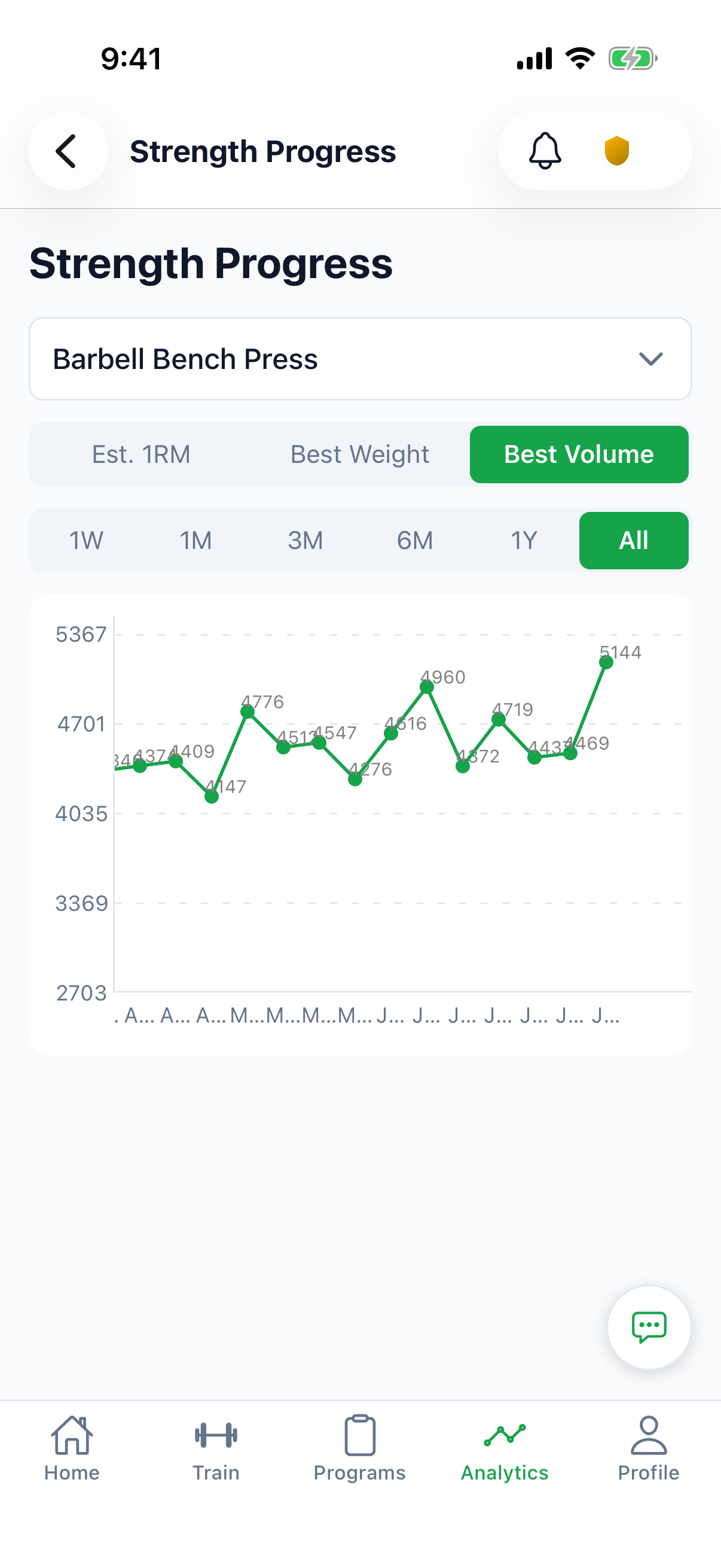
The Strength Progress chart plots one exercise over time, and you choose what it plots. Est. 1RM is the estimate; Best Weight and Best Volume are the two honest, directly-measured alternatives. Best Weight is the heaviest single load you put on the bar that day — no formula. Best Volume is the total work — weight times reps, summed across your sets. Different questions, different lines, zero estimation on two of the three.
See it in the app
Open the Analytics tab
Tap Strength Trend to open Strength Progress
Select an exercise you’ve been training
Set the metric toggle to Best Weight or Best Volume — the chart re-plots instantly
Even this is in Bronze — the whole tracker is $1/mo, and nothing here is locked behind a higher tier.
Why it matters
Getting stronger doesn’t always show up the same way. Some blocks your top-end load climbs; others your top single is flat but you’re grinding out more total work at that weight. Watching Best Weight and Best Volume as separate lines means progress shows up even when your Est. 1RM hasn’t moved.
Both are things you actually did — the heaviest set you truly completed, the total load you truly moved. Unlike an estimate, there’s no model in between you and the number, so they’re the cleanest possible record of the session.
How Powerhaus calculates it
Best Weight for a session is the single heaviest load you lifted on that exercise — `MAX(weight)` across all your working sets that day. If your heaviest set was 225, Best Weight is 225, full stop.
Best Volume is your total work for that exercise that session — we sum weight × reps across every working set. Three sets of 100×10 is 3,000; it rewards doing more total work, whether that comes from more weight, more reps, or more sets.
Both plot per session across whatever time range you pick (1W through All) — averaged into weekly or monthly points on the longer ranges so the line stays readable — and both exclude warm-ups so rehearsal sets don’t distort it. The third toggle, Est. 1RM, is covered in its own card — see Estimated 1RM.
The science
Total volume is the best-supported single driver of muscle growth we have. Schoenfeld, Ogborn & Krieger’s 2017 meta-analysis found a graded, roughly linear relationship between how much work a muscle absorbs and how much it grows — which is exactly why a Best Volume trend is worth watching, not just your top single.
Load and volume answer genuinely different questions, and sport science treats them as complementary. A re-examination of the repetition continuum (Schoenfeld et al., 2021) shows maximal strength tracks the heavy loads you actually practice while muscle can grow across a wide span of loads — so tracking peak load and total work captures more of your training than either alone.
Neither number needs a formula, and that’s the point. Best Weight and Best Volume are recorded quantities, not predictions — they carry zero estimation error. We reserve estimation strictly for the 1RM, the one number you can’t safely test every session.