Muscle Heat Map
A body map that shades each muscle by how much work it’s absorbed — so you can see at a glance what you’re hammering and what you’re neglecting.
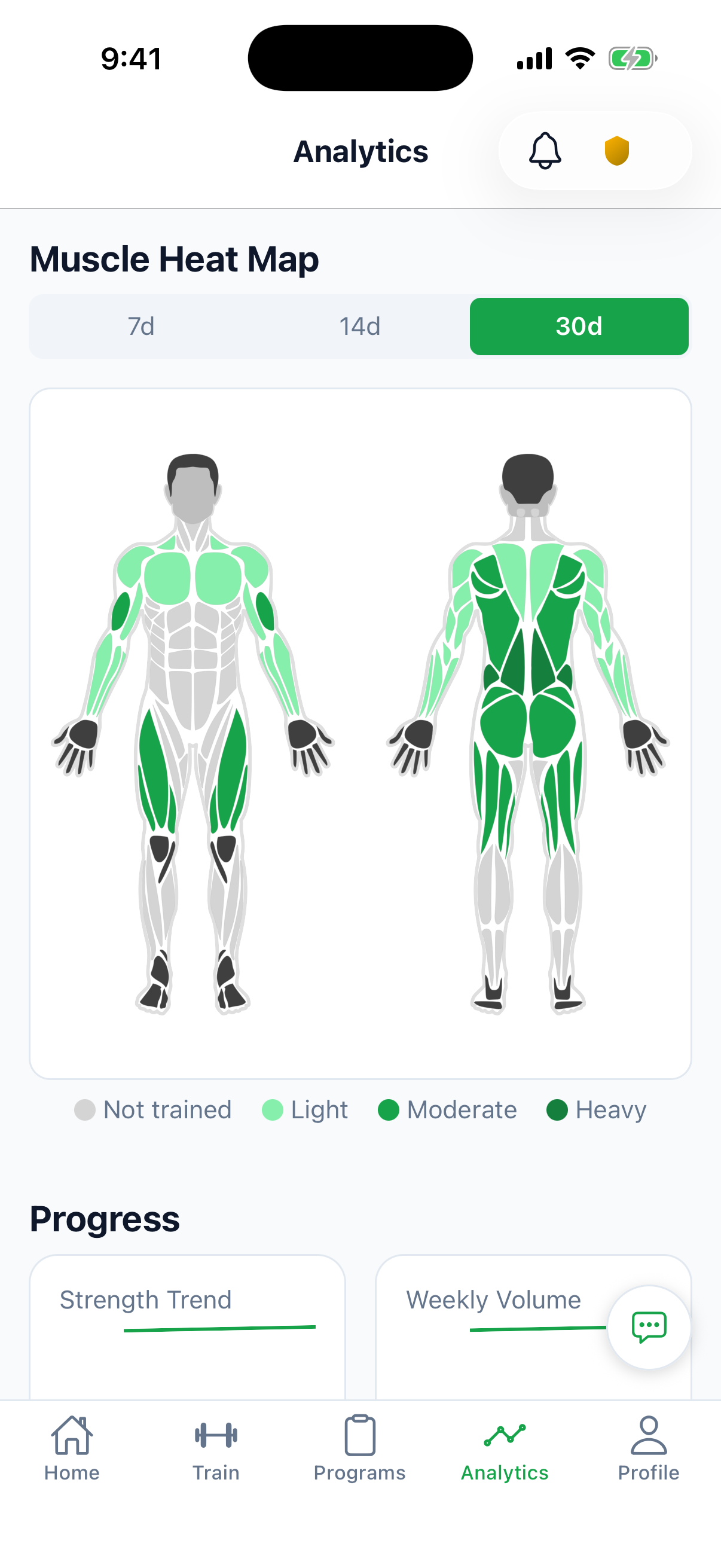
The heat map takes every working set you log, works out which muscles each exercise trains, and shades a body diagram accordingly. It answers one honest question — which muscles am I emphasizing, and which am I neglecting, relative to the rest of my body — over whatever time window you pick. It’s a relative map, not a report card: the color is a within-you ranking, not a verdict on whether you’ve done “enough.”
See it in the app
Open the Analytics tab
The Muscle Heat Map is the first thing on the screen — a front-and-back body diagram
Use the range control (7d / 14d / 30d) to change the window
Tap any muscle to see the exercises that trained it in that window
Even this is in Bronze — the whole tracker is $1/mo, and nothing here is locked behind a higher tier.
Why it matters
Muscles don’t grow from any single lift — they respond to how much hard work each one accumulates over time. Spread across a dozen exercises and several weeks, that’s genuinely hard to eyeball. The heat map collapses it into one glance: warm muscles are the ones getting your attention, cool ones are quietly falling behind.
It’s how you catch the imbalances every lifter drifts into — the neglected posterior chain, the pull volume that never quite matches the push. Seeing a muscle group sitting cool is the nudge to program it back in before it becomes a weak point.
How Powerhaus calculates it
For every working set (warm-ups excluded), we take its volume — weight × reps — and credit it to each muscle that exercise trains, using the muscle map behind each exercise. A heavy bench set adds to chest, triceps, and front delts together. For bodyweight lifts, the “weight” is an estimate of the bodyweight you moved (see Bodyweight as Load).
We sum that volume per muscle over the window you choose (7, 14, or 30 days), then color each muscle by its rank against your own other trained muscles on a green scale: the top third are the deepest green (Heavy), the middle third mid-green (Moderate), the rest pale green (Light), and anything untrained stays gray. Tap any muscle to see which exercises drove it.
One subtlety worth naming: several groups — chest, delts, traps, back — are built from multiple anatomical heads in our database. We credit each working set once per muscle group, not once per head, so a bench set counts for chest a single time and a three-head group like the delts can’t get artificially outsized against a single-head muscle like biceps or quads. That keeps the ranking an honest, apples-to-apples comparison across your body.
The science
The premise — that accumulated volume per muscle drives growth — is one of the best-supported ideas in resistance training. Schoenfeld, Ogborn & Krieger’s 2017 meta-analysis found a graded, roughly linear relationship between weekly training volume and muscle growth. So a map of where your volume is going is a genuinely useful lens.
But we owe you honesty about the unit. The volume research is built on counting hard sets per muscle per week, not on tonnage (weight × reps). A heavy set of 5 and a lighter set of 15 taken to failure grow muscle comparably despite very different tonnage — so tonnage over-weights heavy, low-rep work. Our heat map uses tonnage, which makes it a solid relative signal but not the exact currency the science uses: a muscle can rank “hot” partly because its lifts are heavy compounds, not because it got the most stimulating sets. (Stronger by Science walks through why hard sets became the field’s preferred unit.)
We also give every muscle an exercise touches the full credit for the set — the bench press counts fully for chest, triceps, and delts. Crediting synergists a fraction of a set would arguably be more precise; we chose the simpler, more legible rule for a diagram meant to be read in a glance.