Personal Records
Three records per lift — your best single, five, and ten — tracked automatically from the sets you were already doing.
A personal record is the cleanest proof training is working. Powerhaus tracks three per exercise — an estimated 1-rep max, a 5-rep max, and a 10-rep max — and reads them straight off your normal working sets, so you never have to stage a max-out day. When one set breaks several records at once, we surface the biggest breakthrough — and the first time a lift ever lands records, that lead is always a real heavy lift, never an estimate.
See it in the app
Finish any workout — a PR celebration appears the moment you beat a record
Open the Analytics tab
Scroll to the Personal Records section and tap View All
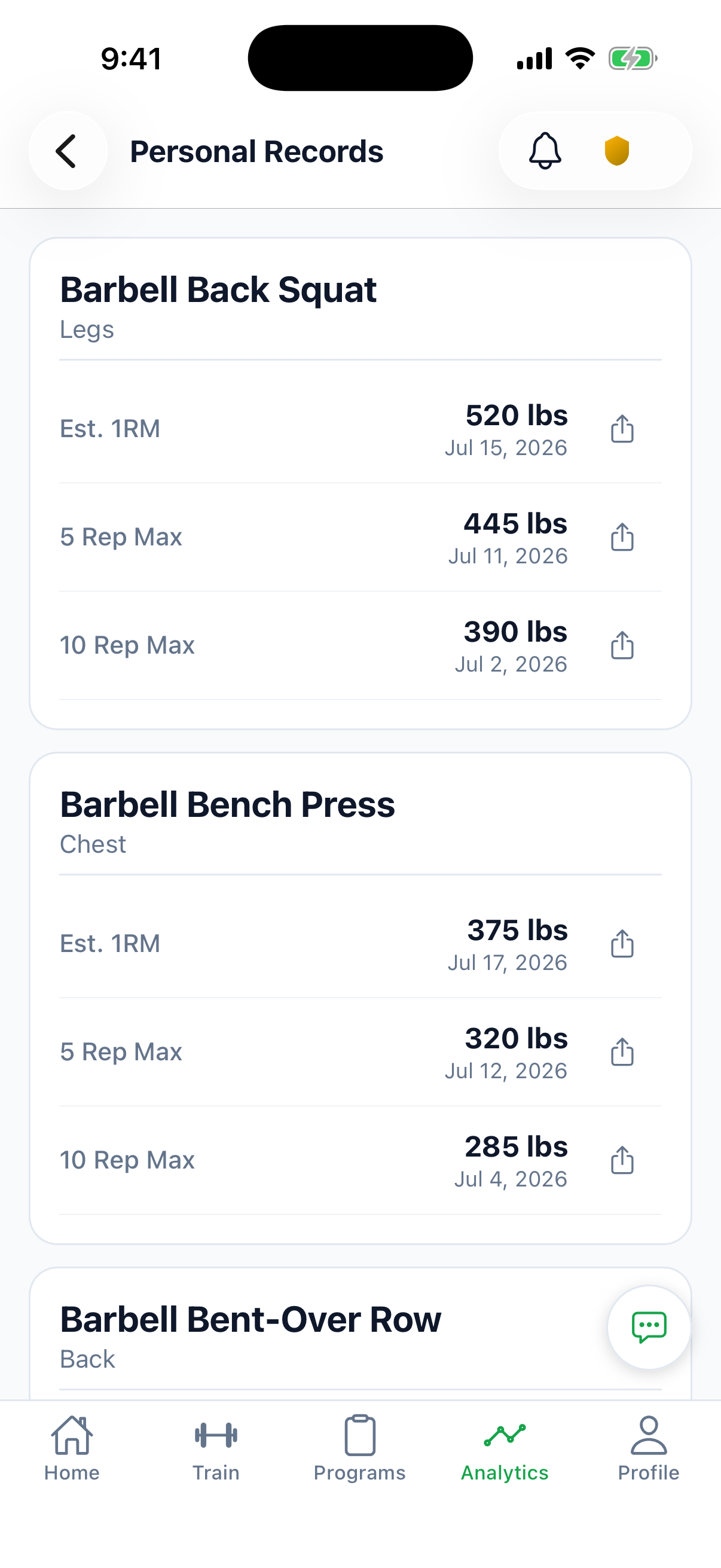
Each exercise lists its Est. 1RM, 5 Rep Max, and 10 Rep Max with the date you set it
Even this is in Bronze — the whole tracker is $1/mo, and nothing here is locked behind a higher tier.
Why it matters
Strength doesn’t only move at the top end. Tracking three bands means progress still shows up when your single hasn’t budged but your 8-rep sets are climbing — and each is a different, honest signal of getting stronger.
Because records come from the sets you were already going to do, a PR is something you discover, not something you have to test for. Grind out a hard set of 6 and you may quietly bank a new 5-rep max — no dedicated, risky max-out session required.
How Powerhaus calculates it
We keep three bands per exercise: an estimated 1RM, a 5-rep max, and a 10-rep max. A set counts toward a band if it hits at least that many reps — a hard set of 6 counts toward your 5-rep max.
For the 5- and 10-rep bands we store the actual weight on the bar — a directly observed number, no formula involved. Only the 1RM band is an estimate (see Estimated 1RM), and its rep input is capped so a high-rep set can’t inflate it into a fake record.
When one set breaks more than one record at once, we surface the biggest jump over your previous best and list the others beneath it. And the first time a lift ever lands records, we lead with the most tangible one — a weight you actually lifted, not an estimate.
The science
The 5-rep max isn’t an arbitrary band — it’s the single most accurate submaximal predictor of a true 1RM. Reynolds et al. (2006) found rep-max prediction is tightest at 5 reps (R² up to 0.99) and degrades as reps climb, which is exactly why the 5RM earns its own tracked record.
Storing the actual load for the 5- and 10-rep bands is the more rigorous choice, not the lazy one. A rep max is formally the heaviest weight moved for that many reps — a directly observed quantity, not a formula output — so the higher bands carry zero estimation error. We reserve estimation only for the 1RM, the number you can’t safely observe every session.
There’s deliberately no “test to failure” prompt. Reading records off ordinary working sets exposes you to far less cumulative load and injury risk than literal rep-max testing — a trade the strength-testing literature broadly endorses for anyone who isn’t a competitive lifter.