Recovery
A read on which muscles are fresh and which you’ve hit recently — a training-frequency compass, told honestly as a clock, not a verdict.
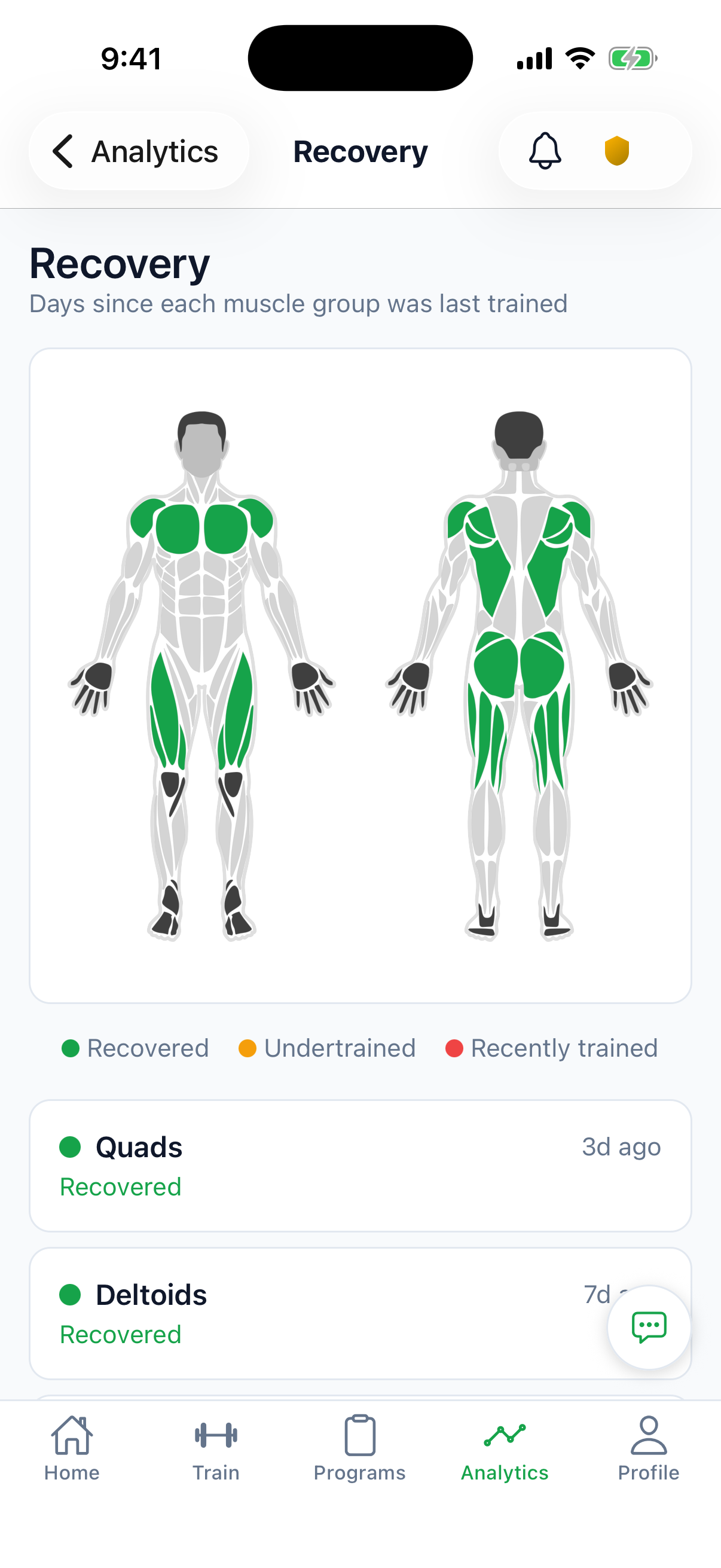
Recovery shows how long it’s been since you last trained each muscle as its primary mover, and buckets it: under 48 hours reads as freshly worked, over a week as under-trained, in between as recovered. It’s a genuinely useful frequency compass — but be clear on what it is: a calendar clock, not a physiological read. It knows when you last trained a muscle, not how hard.
See it in the app
Open the Analytics tab
Scroll to Advanced — Gold (the Training Intelligence suite)
Tap the Recovery card
Each muscle shows days since it was last trained and its recovery state
Part of the Gold Training Intelligence suite — the deeper analytics layer for lifters who want the full picture.
Why it matters
Muscle responds well when it’s trained roughly twice a week — often enough to keep the stimulus coming, spaced enough to recover between. Seeing at a glance which muscles you hit two days ago and which you haven’t touched in ten is a fast way to keep that rhythm.
It’s a planning tool: a muscle sitting in “under-trained” for a week is your nudge to program it back in, and a whole region reading “freshly worked” is a reason to train something else today.
How Powerhaus calculates it
For each muscle, we find the most recent date you trained it as a primary mover (secondary involvement and warm-ups don’t count), and measure the days since.
We bucket that: under 48 hours → freshly worked; over 7 days → under-trained; anything in between → recovered. The 48-hour floor is a defensible midpoint of how recovery timelines actually run.
That’s the whole model — a clean, cheap, transparent days-since clock per muscle. It deliberately doesn’t try to model load, because the load data a real recovery model would need isn’t something we’d want to fake precision around.
The science
48 hours is defensible, not magic. Muscle protein synthesis peaks around 24 hours after a hard session and largely settles by ~36 hours (MPS time course) — but force and soreness recover on their own, slower timelines. Different parts of recovery finish at different times, so 48h is a reasonable middle, not a precise line.
The days-since clock’s biggest blind spot is load. In one study, how long recovery actually took swung roughly 8-fold depending on the session — 48 hours after a hard, high-velocity-loss set versus about 6 hours after an easy one (load & recovery review). Two sessions that both “count” as training a muscle can need wildly different real recovery a calendar can’t see.
The boundaries line up with frequency research. Training a muscle around twice a week is a well-supported, practical target for hypertrophy (frequency meta-analysis), so flagging a muscle only after a full week untouched is reasonable — real detraining doesn’t begin for weeks (detraining meta-analysis).