Plate Calculator
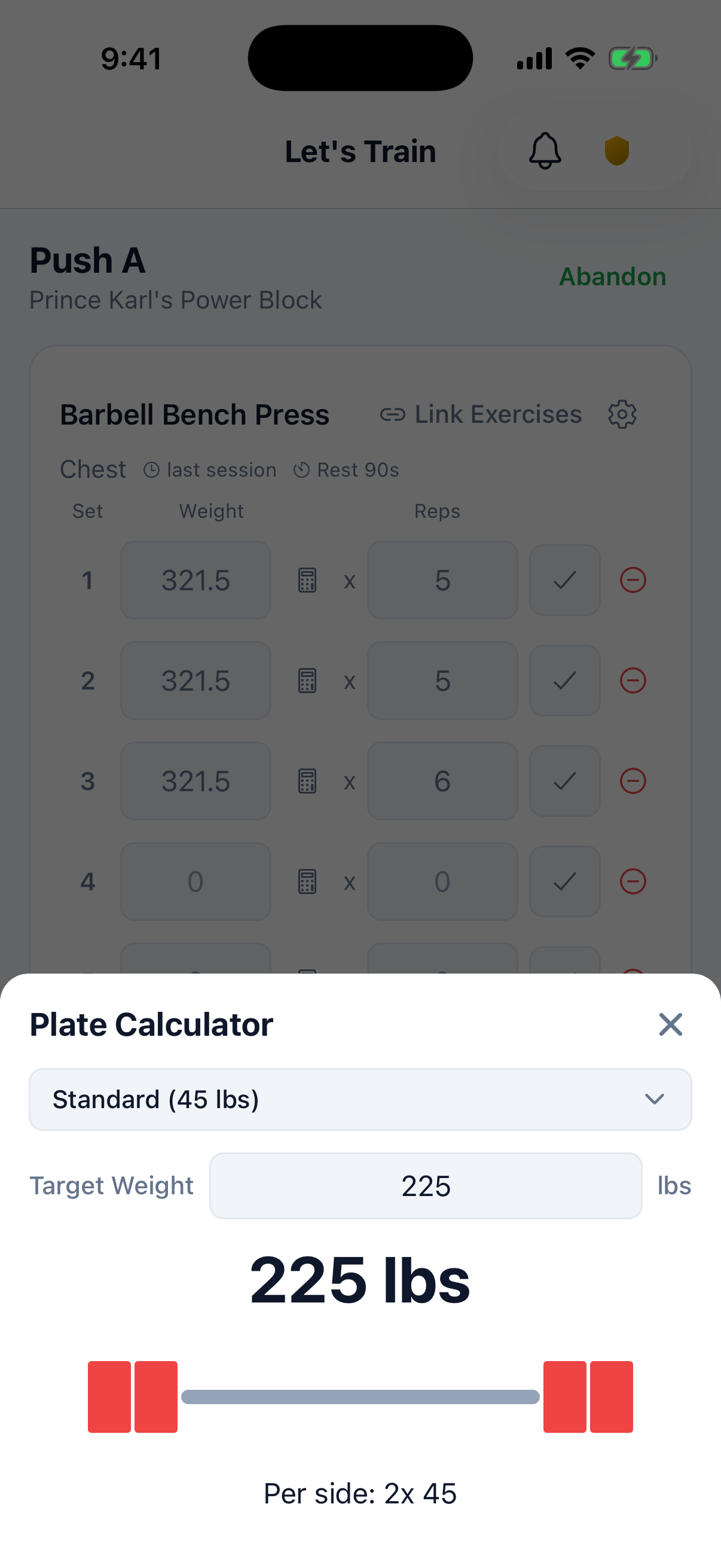
Tell it a target weight and it shows you exactly which plates go on each side — drawn out so you can match the bar plate for plate.
Loading a barbell is simple arithmetic that’s annoying to do mid-set: subtract the bar, halve the rest, and fill from the biggest plate down. Powerhaus does it for you and draws the bar so you can match it plate-for-plate. The “biggest-first” method is fast and, for standard kilogram plates, provably the fewest-plates solution. When a target can’t be built exactly from your plates, we round to the nearest buildable weight and tell you how far off it is.
See it in the app
Start or open a workout
On any set, tap the barbell icon to open the Plate Calculator
Enter a Target Weight and tap the bar selector to switch bar type
Read the per-side plates and the barbell diagram; a notice appears if the weight was rounded
Even this is in Bronze — the whole tracker is $1/mo, and nothing here is locked behind a higher tier.
Why it matters
Doing this math in your head between heavy sets is exactly when you don’t want to. A glanceable “two 45s and a 10 per side” removes a small, repeated friction from every working set.
It also catches loading mistakes. Seeing the plates laid out — and the total the app computes — is a quick check that the bar in front of you actually weighs what your program called for.
How Powerhaus calculates it
We take your target, subtract the bar (45 lb / 20 kg by default, with Women’s, Trap, and EZ-curl presets), and halve what’s left for one side: `(target − bar) ÷ 2`.
We then fill that per-side number greedily, largest plate first — as many 45s as fit, then 35s, and so on down to the smallest plate. The bar diagram shows the heaviest plate nearest the collar, exactly how you’d load it.
If the per-side number isn’t buildable from standard plates, we round to the nearest loadable weight and show a notice like “185 lb (2 lb off from 183 lb)” so the rounding is never silent.
The science
Greedy “biggest-first” is fast, and for standard kilogram plates it’s provably optimal. Divide every kg plate by the smallest one and they map onto a canonical number system where greedy is mathematically guaranteed to use the fewest plates (tommyodland, 2020). The common pound set behaves a little differently — greedy always gives you a clean, correct loading, but for some targets a hand-picked combination could shave off one plate. We favor the fast, predictable rule.
The per-side halving rule is universal — every barbell calculator solves the same little equation because plates load symmetrically on both ends (Fitness Volt). There’s no cleverness to add here; the honesty is in what happens at the edges.
We keep the math floating-point-safe on purpose. The smallest plates (2.5 lb, 1.25 kg) are exact in binary, so the running remainder can’t drift into a rounding glitch, and a dedicated guard means a bad input can never render a broken bar.