Deload Detection
Spots the weeks where your training volume dropped hard — a useful mirror on your history, held up against a science that’s honestly still arguing with itself.
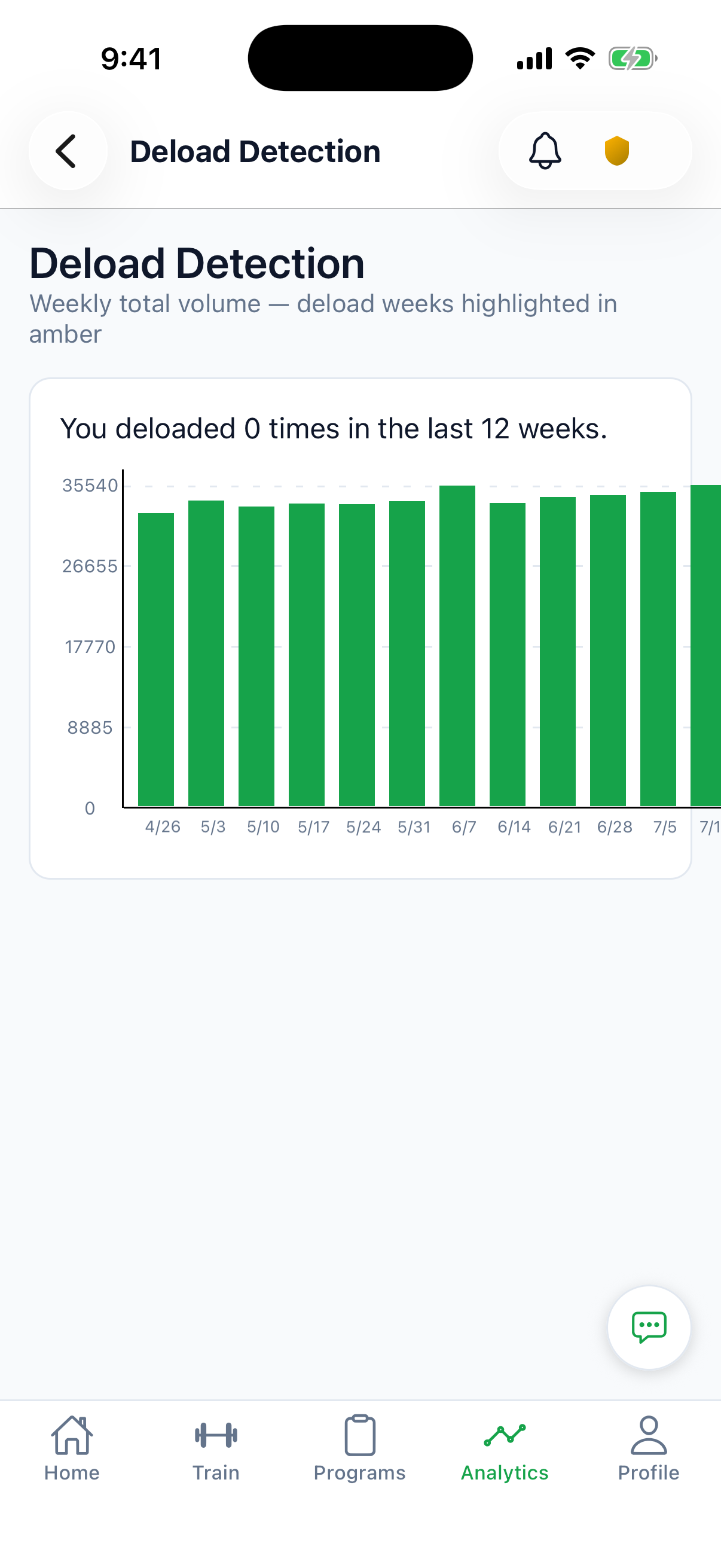
Deload detection flags a past week whose total volume fell more than 30% below your rolling 4-week average — the fingerprint of a deload, a missed week, or a program shift. The 30% cutoff sits right in the range coaches actually use. Two honest notes: it’s retrospective (it recognizes a light week, it doesn’t predict one), and whether scheduled deloads are even necessary is a genuinely unsettled question in the research.
See it in the app
Open the Analytics tab
Scroll to Advanced — Gold (the Training Intelligence suite)
Tap the Deload Detection card
Weeks that fell >30% below your rolling average are flagged in your history
Part of the Gold Training Intelligence suite — the deeper analytics layer for lifters who want the full picture.
Why it matters
Volume tells a story your memory smooths over. A clear map of which weeks were light — planned or not — helps you see whether your training actually periodizes or just drifts.
Recognizing a deload week for what it is also keeps you from misreading it. A big volume drop that was a planned easy week isn’t a warning sign — and seeing it labeled as a deload rather than a red flag is the point.
How Powerhaus calculates it
Each past week, we total your training volume across the muscles you trained, then compare it to your rolling 4-week average.
If a week came in more than 30% below that average, we flag it as a likely deload. 30% is a magnitude that brackets real coaching practice — enough of a drop to be deliberate, not just noise.
It’s whole-body and it looks backward — it reads the volume you’ve already logged and names the light weeks. It doesn’t forecast fatigue or tell you to deload next week.
The science
The 30% magnitude matches what coaches actually do. A study of elite coaches describes real-world deloads as roughly 30–50% volume reductions every 4–8 weeks (Bell et al., 2022), and a 34-coach Delphi consensus agrees the primary deload method is cutting volume, not taking full rest (Bell et al., 2023). So a >30% drop is a sensible fingerprint.
But whether deloads are strictly necessary is genuinely unsettled — and we won’t pretend otherwise. A 2024 randomized trial found a mid-program deload — a full week off, in that trial — actually reduced lower-body strength gains versus training straight through (Coleman et al., 2024) — a direct contradiction of the usual advice. (That trial carries a disclosed commercial conflict of interest, which we mention rather than bury.) The field hasn’t resolved this because almost nobody has run the controlled comparison.
The better-evidenced approach is proactive, and we’re honest that this isn’t that. Signals like velocity-loss and RPE/RIR creep can suggest easing off before performance drops (autoregulation review). Our detection is the rear-view mirror; those would be the windshield.
Sources
- Bell et al. (2022), Frontiers — elite coaches: 30–50% volume cuts every 4–8 weeks
- Bell et al. (2023) Delphi — deload = volume reduction, not full rest
- Coleman et al. (2024) RCT — a mid-program deload reduced strength gains (COI disclosed)
- Autoregulation review — velocity-loss / RIR as proactive fatigue signals